
The Pythagorean Theorem is a fundamental concept in geometry, widely used to solve problems involving right triangles. It's a cornerstone of trigonometry and a vital tool for understanding spatial relationships. This article will delve into the intricacies of the Pythagorean Theorem, explaining its principles, how to apply it, and providing helpful resources for students and practitioners alike. Understanding this theorem unlocks a deeper appreciation for geometric concepts and allows for accurate calculations in a variety of applications. Let's begin!
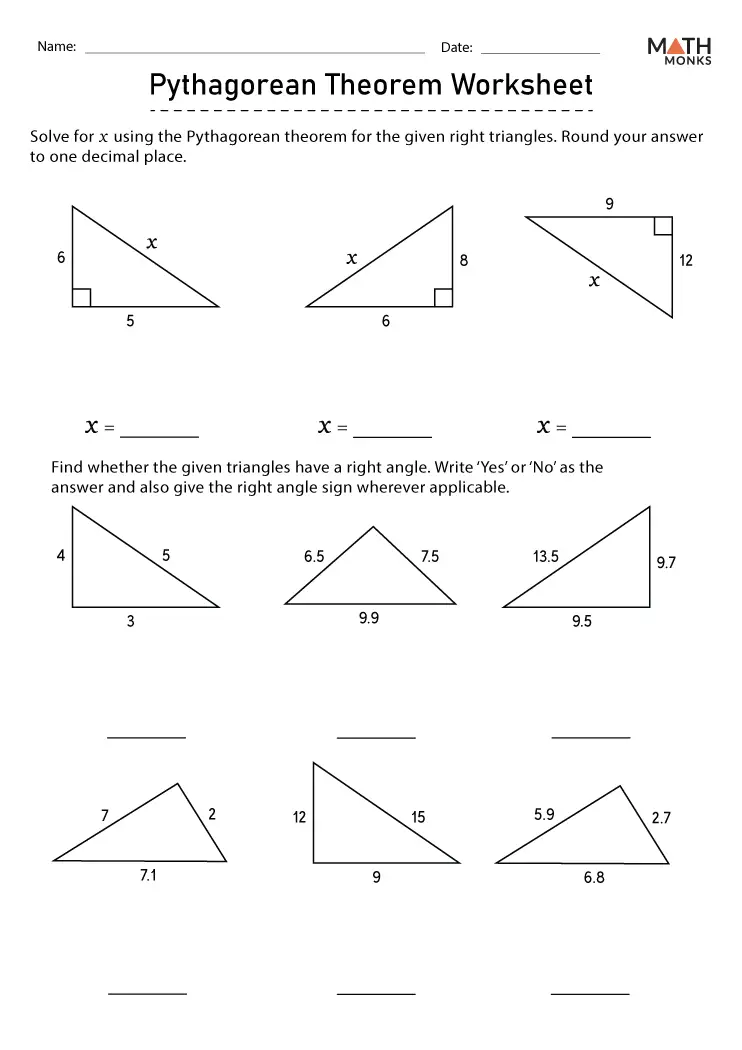
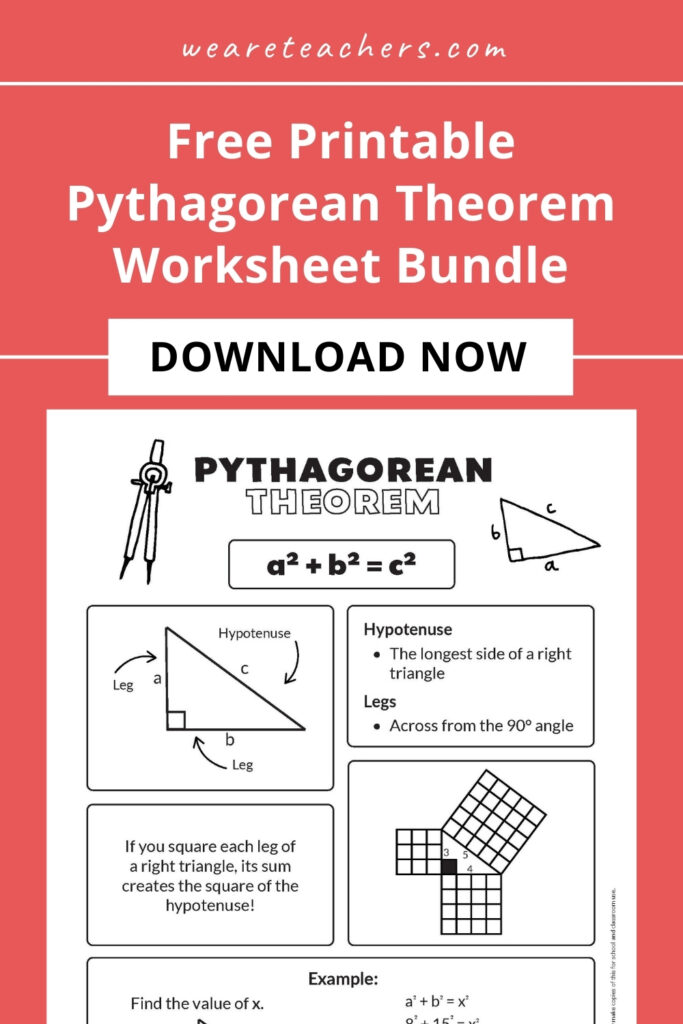
The Pythagorean Theorem is a relationship between the sides of a right triangle. A right triangle is a triangle with one angle measuring exactly 90 degrees. The theorem states that the square of the length of the side opposite the right angle is equal to the sum of the squares of the lengths of the other two sides. Mathematically, this is expressed as: a² + b² = c², where 'a' and 'b' are the lengths of the legs (the sides forming the right angle), and 'c' is the length of the hypotenuse (the side opposite the right angle). It's a powerful tool for solving problems where you need to find the length of a side of a right triangle.
Understanding the Basics
Before diving into the formula, it's helpful to grasp the concept of a right triangle. A right triangle has one angle measuring exactly 90 degrees. The sides that form the right angle are called the legs, and the side opposite the right angle is called the hypotenuse. The Pythagorean Theorem provides a direct way to calculate the length of any side if you know the lengths of the other two sides. It's a fundamental principle that underpins many geometric problems.

The Formula
The formula for the Pythagorean Theorem is: a² + b² = c²
Where:
* 'a' and 'b' are the lengths of the legs of the right triangle.
* 'c' is the length of the hypotenuse.
This formula is incredibly useful because it allows you to calculate the length of any side of a right triangle if you know the lengths of the other two sides. It's a cornerstone of geometry and a frequently encountered concept.

Applying the Pythagorean Theorem
Let's illustrate this with a simple example. Imagine a right triangle where one leg (a) is 3 units long and the other leg (b) is 4 units long. We want to find the length of the hypotenuse (c).

Using the Pythagorean Theorem:

3² + 4² = c²
9 + 16 = c²
25 = c²
To find 'c', we take the square root of both sides:
c = √25
c = 5

Therefore, the length of the hypotenuse is 5 units. This is a common problem that can be solved quickly and accurately using the Pythagorean Theorem.
Solving Right Triangle Problems
The Pythagorean Theorem isn't just for finding side lengths. It's also used in a wide range of problems. Here are a few examples:

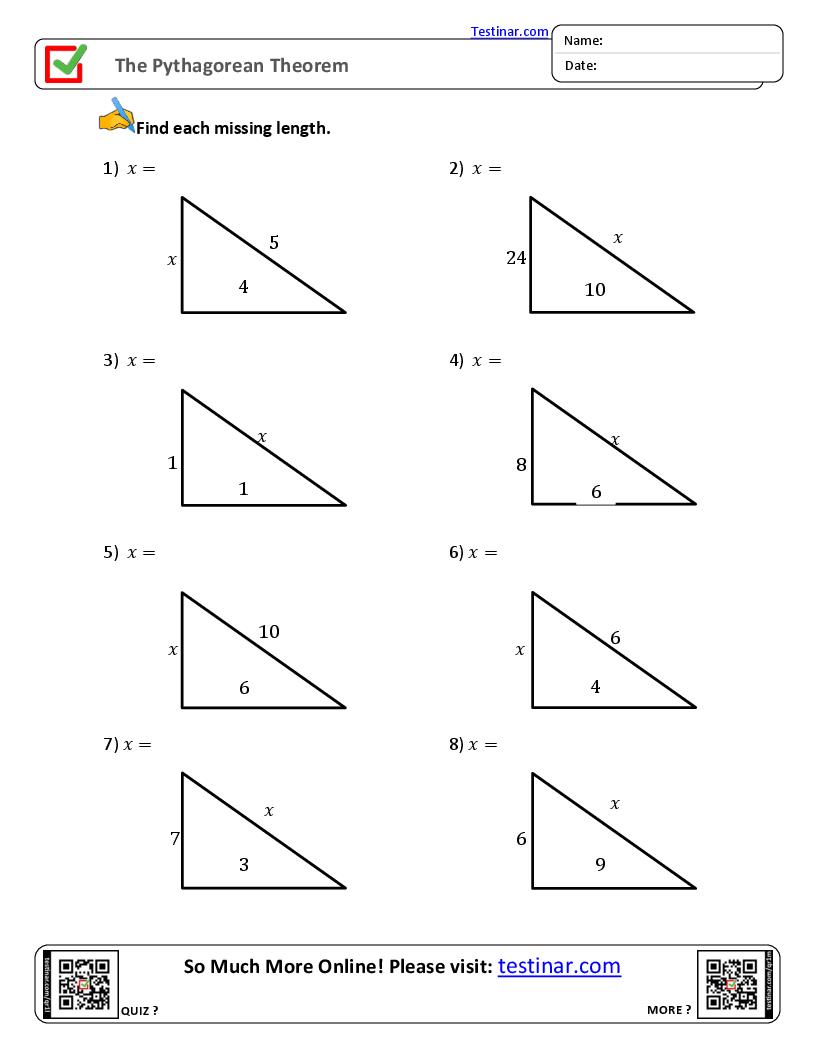
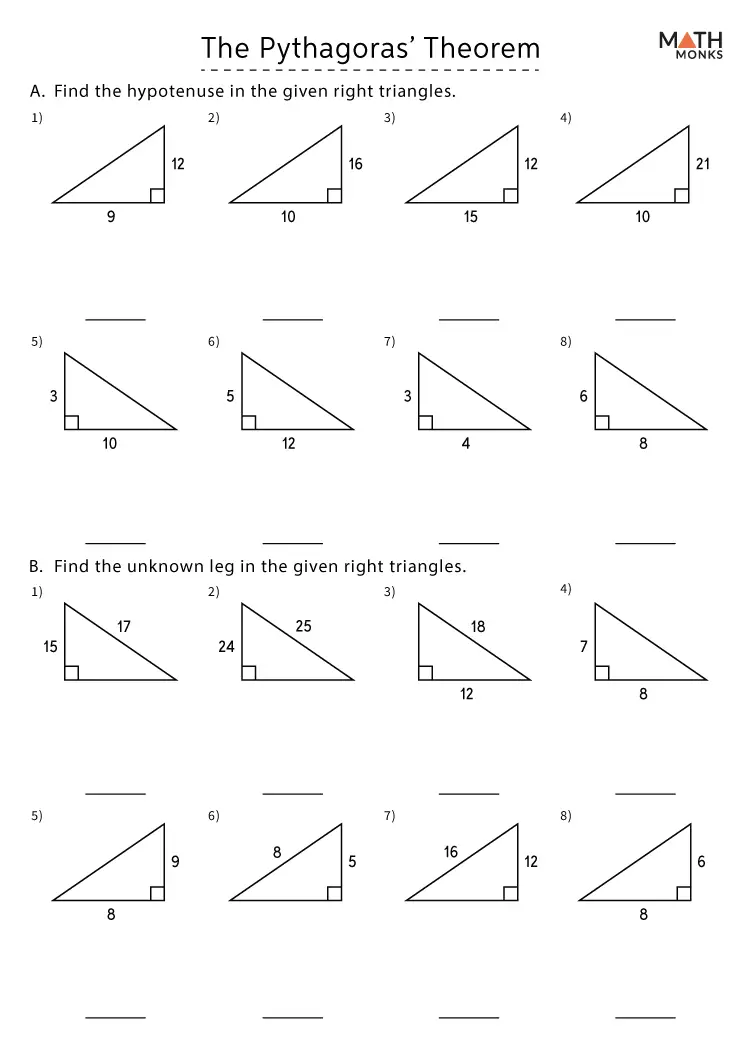
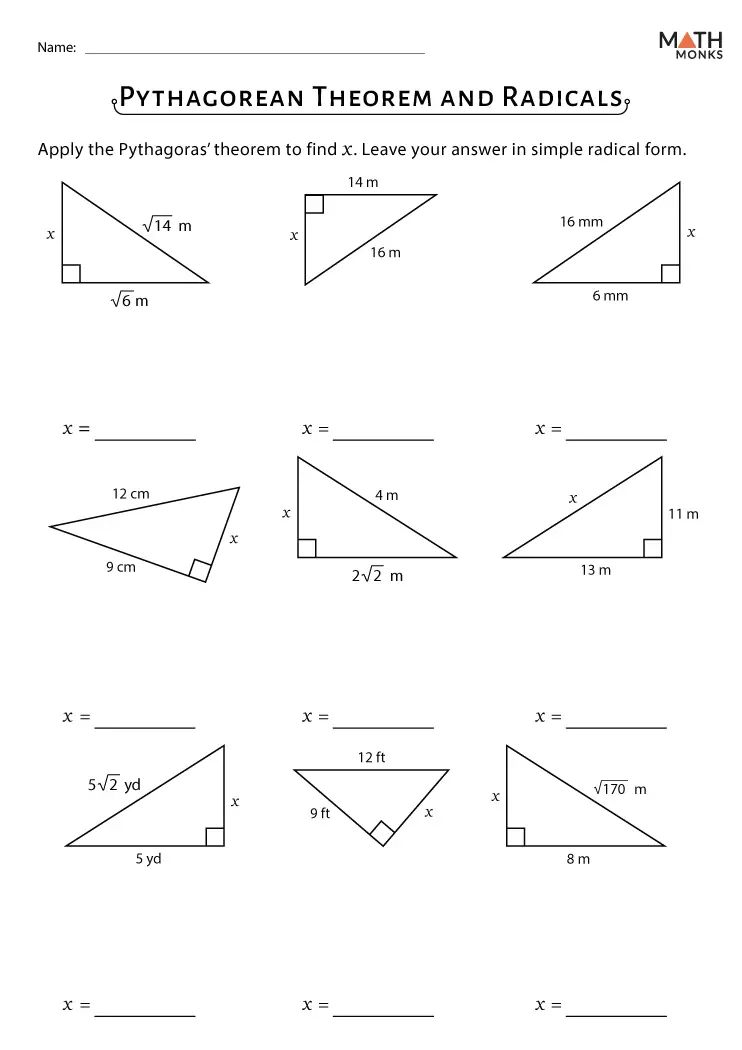
Finding the missing side: If you know the length of one side and the hypotenuse, you can use the theorem to find the length of the missing side. For example, if a = 6 and c = 8, then b = √(c² - a²) = √(8² - 6²) = √(64 - 36) = √28 = 2√7.
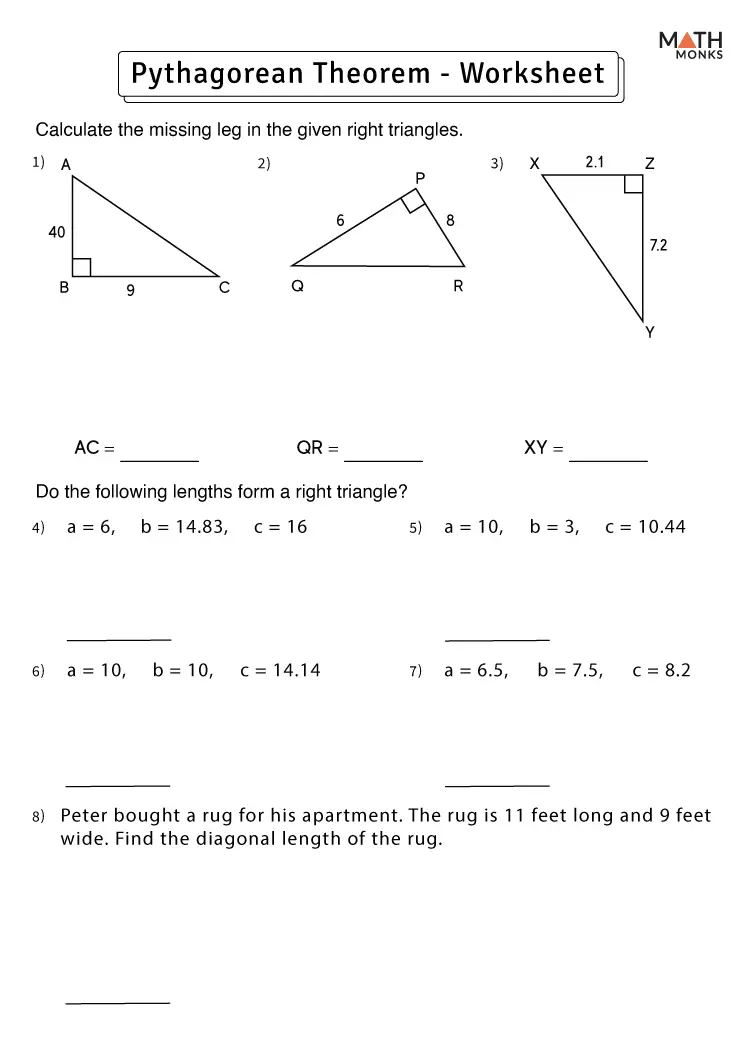
Determining if a triangle is a right triangle: You can use the theorem to check if a triangle is a right triangle. If the sum of the squares of the legs is equal to the square of the hypotenuse, then the triangle is a right triangle.
Calculating the area of a triangle: The area of a triangle can be calculated using the formula: Area = (1/2) * base * height. In a right triangle, the two legs can be considered the base and height.
Variations and Extensions
The Pythagorean Theorem has several variations and extensions that can be useful in more complex problems. One common variation is the Pythagorean theorem for triangles with angles greater than 90 degrees. This involves using trigonometric functions (sine, cosine, and tangent) to solve for unknown sides.
Real-World Applications
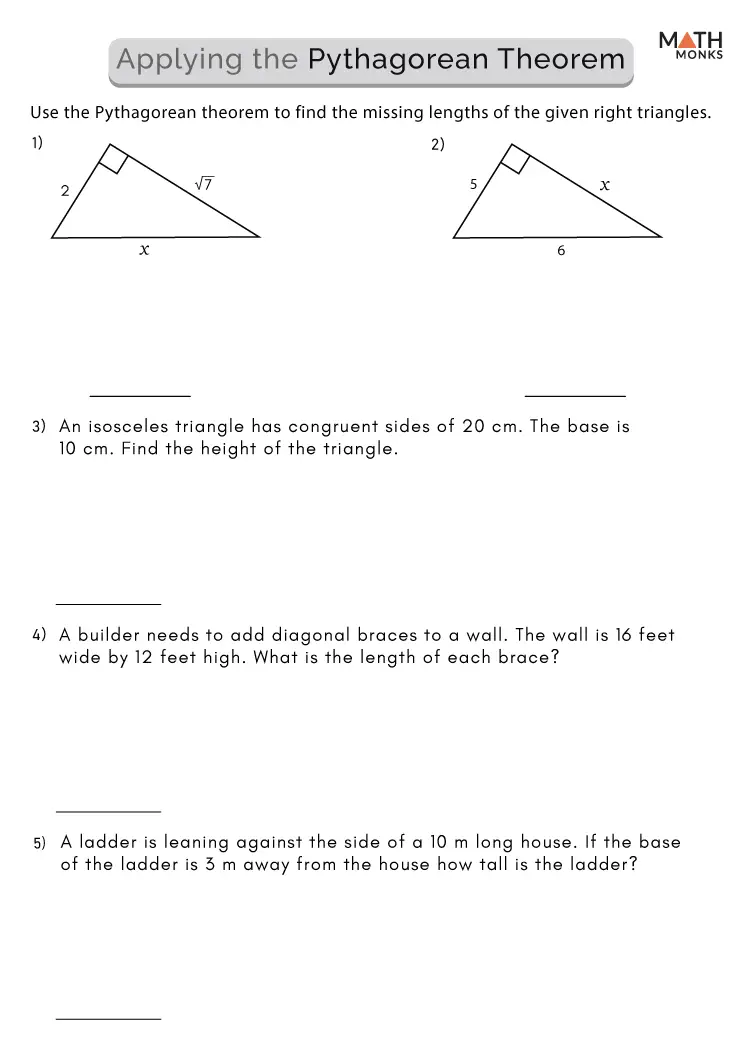
The Pythagorean Theorem has countless real-world applications. Consider construction, surveying, navigation, and even architecture. Engineers and architects routinely use it to ensure accurate measurements and designs. For instance, in building a house, the Pythagorean Theorem is used to calculate the length of a support beam to ensure the structure is stable. Even in everyday life, you might use it to figure out how far a ladder reaches.
Beyond the Basics: Advanced Concepts
While the basic Pythagorean Theorem is fundamental, there are some more advanced concepts related to it. One important concept is the Pythagorean triple, which is a set of three positive integers (a, b, c) that satisfy the equation a² + b² = c². These triples are frequently used in geometry and trigonometry to generate right triangles. Understanding the Pythagorean triples is crucial for solving many geometric problems efficiently.
The Pythagorean Triple
The most common Pythagorean triple is (3, 4, 5), where 3² + 4² = 5² (9 + 16 = 25). This triple is frequently used to generate right triangles.
Resources for Further Learning
If you're interested in exploring the Pythagorean Theorem in more detail, here are some helpful resources:
- Khan Academy: https://www.khanacademy.org/math/geometry/pythagorean-theorem
- Math is Fun: https://www.mathsisfun.com/pythagorean-theorem.html
- YouTube: Search for "Pythagorean Theorem" on YouTube for numerous video tutorials.
Conclusion
The Pythagorean Theorem is a cornerstone of geometry, providing a powerful and versatile tool for solving a wide range of problems. From calculating side lengths to understanding spatial relationships, this theorem is an essential skill for anyone working with geometry. By understanding its principles and applying it correctly, you can confidently tackle a vast array of geometric challenges. Remember to always double-check your calculations and understand the underlying concepts to ensure accuracy. The Pythagorean Theorem Worksheet is a valuable tool for reinforcing this fundamental knowledge. Its simplicity belies its profound impact on our understanding of the world around us.
0 Response to "The Pythagorean Theorem Worksheet"
Posting Komentar